
By Peter Tammes (Office for National Statistics, United Kingdom)
Excess deaths are often discussed in relation to major shocks: pandemics, heatwaves, conflicts, or other acute events. They are defined in statistics as the difference between the number of people who died during a given period and the number of deaths that would have been expected. The central methodological challenge is therefore not simply counting deaths but estimating the expected number of deaths in a way that is coherent, transparent and suitable for regular statistical production.
While excess mortality is expressed as a statistical measure, it ultimately reflects changes in the number of people dying and therefore has significance for families, communities and public services across the UK. Understanding these patterns can help inform public discussion and decision-making about population health, as well as improving our understanding of how different events and circumstances affect people’s lives.
In academic and public debates, excess mortality is frequently used to assess the mortality impact of a specific crisis. From a public sector statistical perspective, however, there is also value in thinking about it as something that is continuous, developed, maintained, scrutinised and improved before the next major shock occurs.
This distinction shaped my contribution to the recent GREATLEAP workshop “Bridging methods to measure excess mortality: One epidemic, Many estimates” at the London School of Economics. Much of the discussion focused, understandably, on how excess deaths can be calculated and used to understand pandemics or other mortality shocks. However, the UK’s Office for National Statistics’ (ONS) perspective is slightly different. We don’t consider excess mortality estimation as a one-off exercise in response to a particular event. We produce ongoing weekly estimates of expected and excess deaths across the UK as published on the ONS weekly deaths dashboard, and on improvements to support that work.
Producing excess death estimates requires balancing statistical and methodological choices with the practical realities of producing official statistics. They depend on baseline period, population change, age structure, mortality trends, and seasonality and the available data. The ONS’s current approach, introduced in early 2024, moved beyond a simple five-year average. Instead, it uses a generalised linear modelling framework, applied to deaths by age group, sex, geography and time period, with population size included as an offset. This allows the estimates to better reflect demographic change and underlying mortality patterns, rather than treating recent historical deaths as directly interchangeable with the present.
As part of ongoing methodological refinement, the ONS has explored different modelling approaches to account for the effect of public holidays. Because ONS deaths data are based on registrations, weeks containing bank or public holidays may have fewer working days and therefore fewer deaths registered, even if the underlying number of deaths occurring has not changed.
The workshop was particularly valuable because it prompted a question that can receive less attention than methodological considerations within official statistics: what is the purpose of estimating excess deaths? While academic studies often seek to answer a specific research question, official statistics must serve a wider and more enduring purpose.
One answer is preparedness. Developing and refining a consistent method during relatively normal periods creates a stronger historical baseline for interpreting future shocks. It also reduces the need for ad hoc methodological decisions when public attention is high and rapid interpretation is required. In that sense, estimating excess deaths is not only about measuring the impact of past events; it is also about maintaining a statistical system that is ready to provide coherent evidence when mortality patterns change.
The workshop highlighted how researchers and statistical producers often approach excess mortality from different starting points or areas of focus. Bringing these perspectives together is valuable. Academic discussions can help challenge and refine the assumptions behind official statistics, while the experience of producing regular statistics can offer a practical perspective on how excess mortality measures are developed, maintained and used over time.
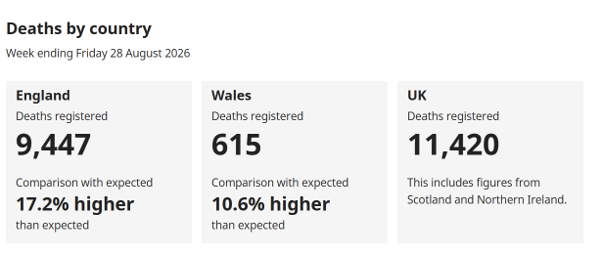
Through its weekly deaths dashboard, ONS publishes continuous estimates of deaths and excess mortality across the UK. While these figures are statistical measures, they reflect changes in mortality that affect families, communities and public services. Maintaining this capability over time helps build a robust evidence base for understanding future health shocks and other changes in mortality.